
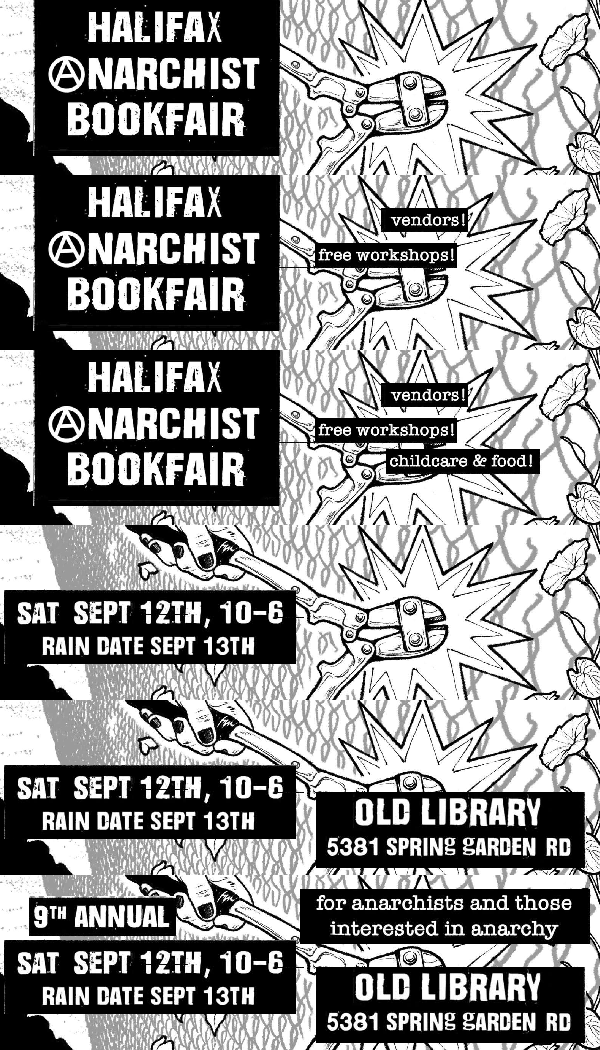
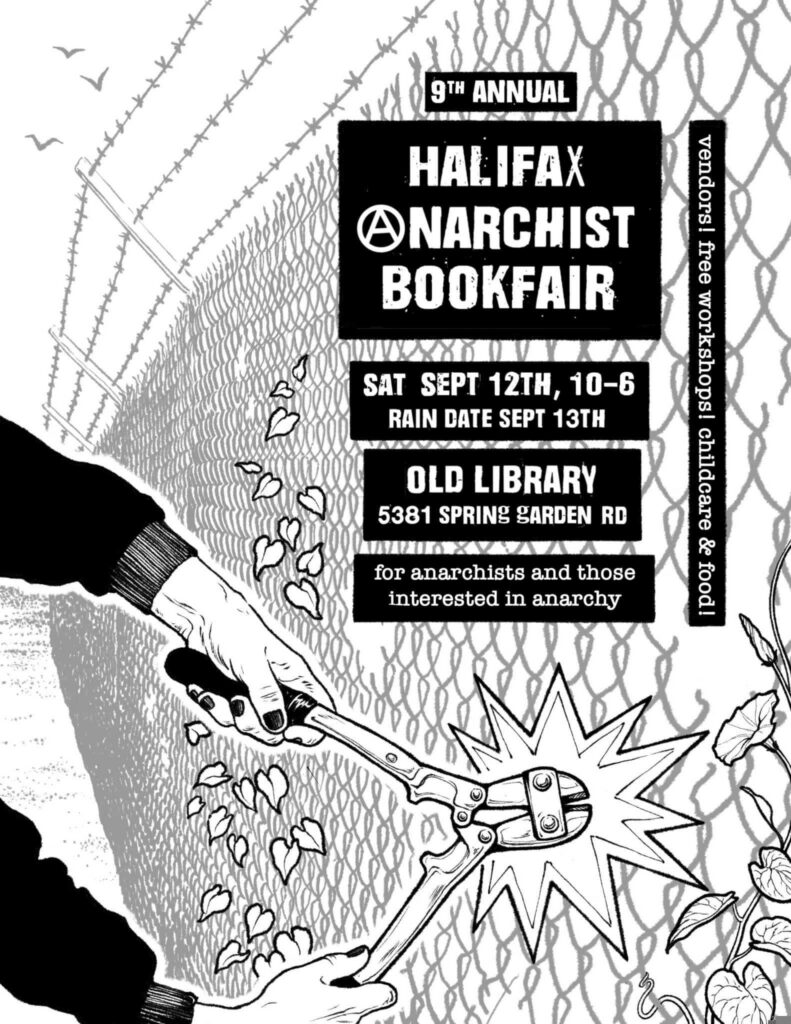
Announcing the 9th Annual Halifax Anarchist Bookfair
Saturday September 12th 2026, Location TBA
{{ Rain Date: Sunday September 13th }}
In every corner of the globe, in every culture, in every language, across time and place, there have been freedom-seeking peoples. They have been labelled fugitives, rebels, revolutionaries, abolitionists and anarchists. Like them, we seek to build social and political projects that speak to the needs of our communities, that weave our joy, grief and resistance into a basket that can hold enough for all to share. History does not remember well people like us, because we build homes and communities that feed each other, care for the land and are a threat to power. Those who seek to rule us build pyramids, cathedrals, skyscrapers, prisons and AI data centers in their vain quests for immortality & domination.
In our quest for autonomy, we recognize that there is no end point to the practice of building and rebuilding, because we know that as soon as one puts trust in a leader and elevates that leader above people – oppression is seeded. We are not capitalists, though we live in a world brutalized by capitalism, colonialism, and Victorian sensibilities of cis-heteropatriarchy. We are not communists,though we live under the oppression of state-nationalism, we dream of communal futures free of authoritarianism, and organize within unions. We are anarchists, even if that word can’t fully describe our diversity. We know that curiosity, solidarity, love, internationalism, mutual aid, and direct action is how we build the world we desire and deserve, even if it doesn’t come quickly.
If you think you or someone you know might be an anarchist, come on down to the Halifax Anarchist Bookfair!
On Saturday, September 12th, 2026 we invite you to join us for Kjipuktuk/Halifax’s 9th Annual Anarchist Bookfair to convene, scheme & dream a liberated world together. All ages are welcome to cultivate curiosity, solidarity & mutual aid through sharing books, zines, art, music, discussion, and skills.
We are specifically looking for workshop proposals and content around the theme Autonomy Beyond Borders. Some potential topics include:
- Autonomous & anarchist movements in the Global South
- International solidarity
- Antifascist resistance in North America/Turtle Island
- Migrant mutual aid and solidarity / anti-border struggles
- Critiques of AI and the techno-fascist project
- Critiques of nationalism, campism, Communism
- What sets anarchism apart from electoral politics of the left
- Indigenous solidarity & sovereignty
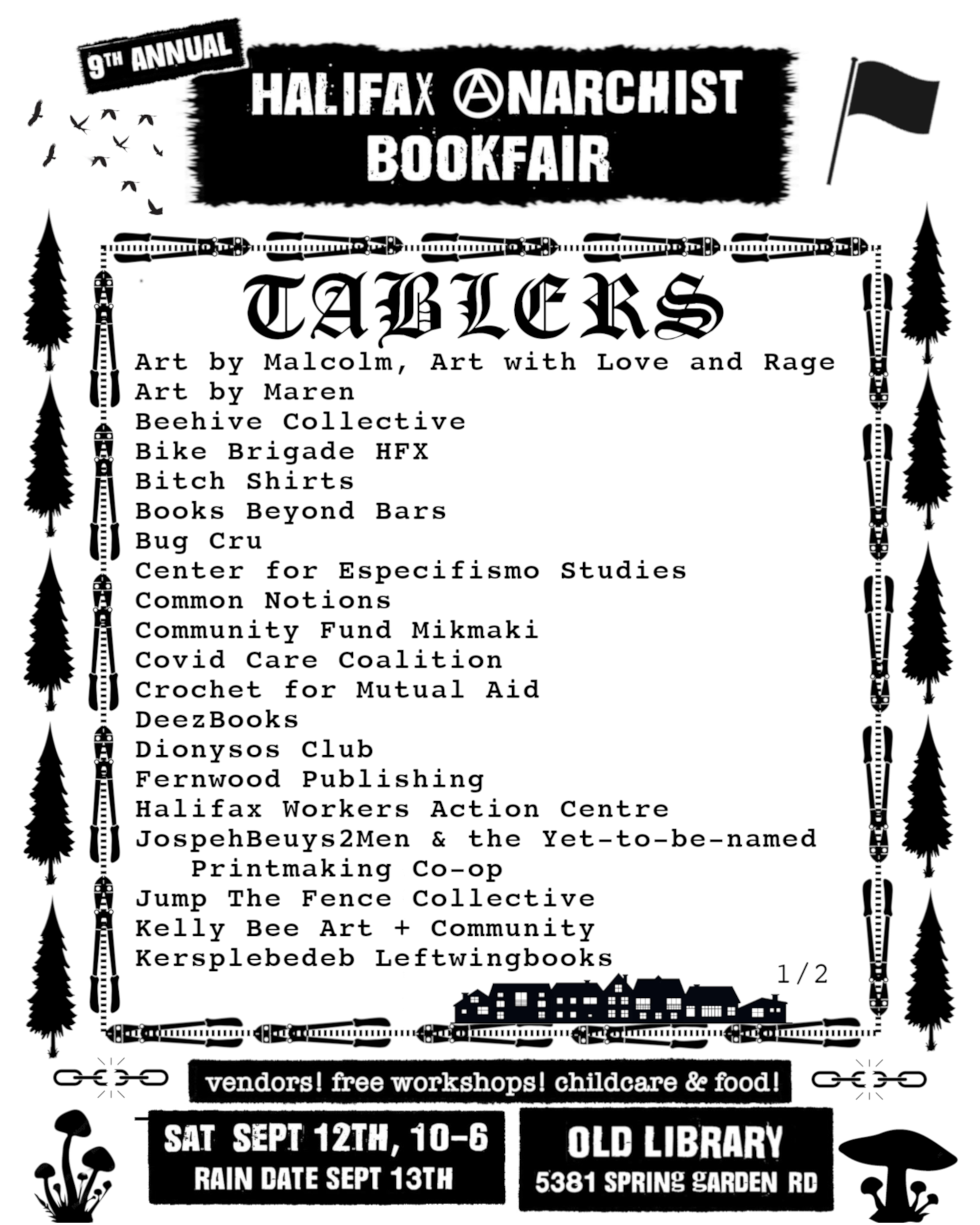
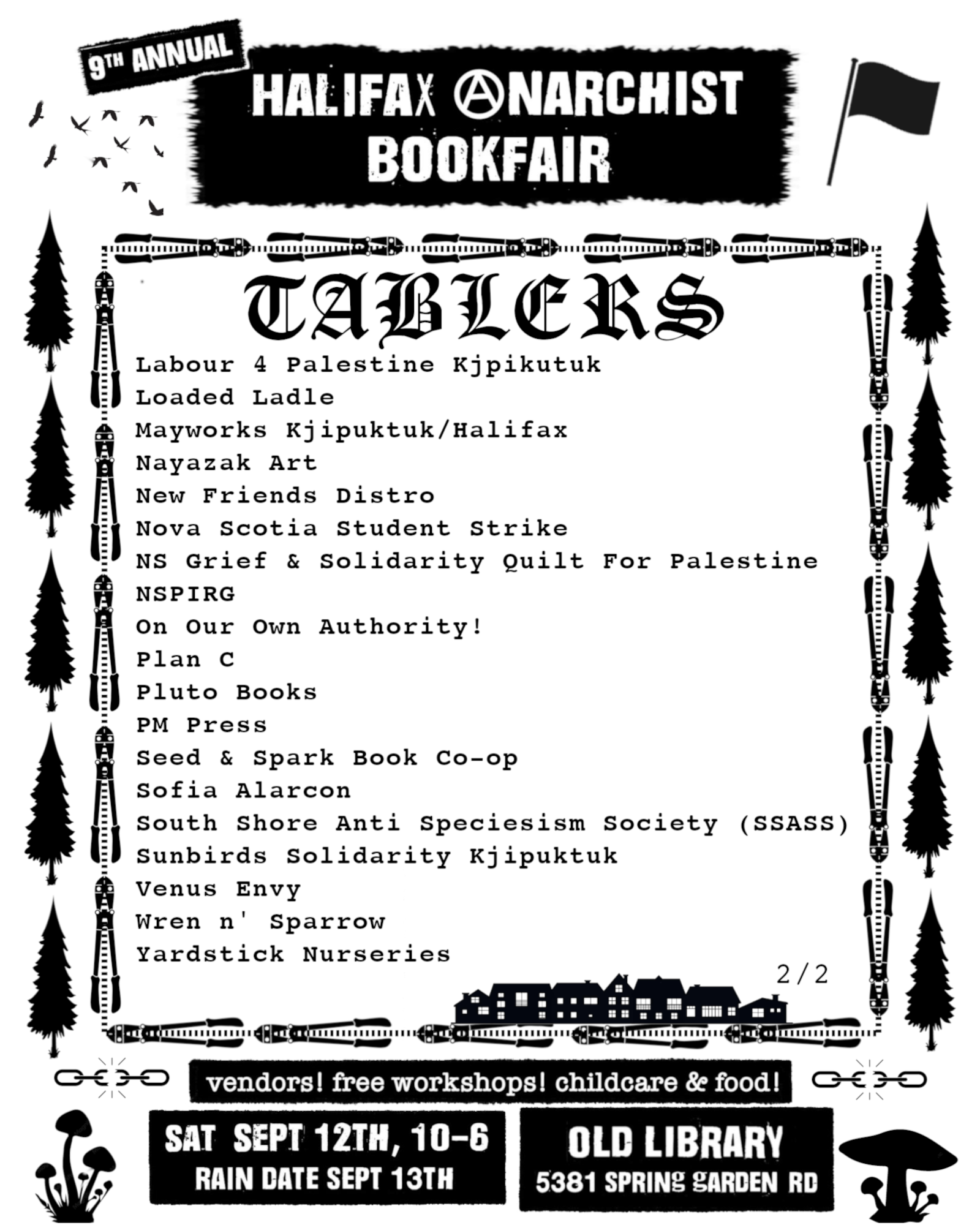
Workshops – Saturday September 12th, 2026
Session one – 11am-12:15pm
Outside 1
Freedom of information as a tool of liberation– Euan Thomson (he/him)
As newsrooms continue to be decimated, the burden of uncovering hidden webs of corruption and deceit increasingly falls on citizens and independent journalists. This workshop will give a brief explanation of the powers and limits of freedom of information law before providing step-by-step instructions on how to submit a request. Participants will come away with their own completed request to submit to one of three public bodies: Halifax Regional Police, the Government of Nova Scotia, and the City of Halifax.
Outside 2
Beyond Prophecy: Resisting Christian Zionism’s Political Agenda– Hannah Wood (she/her)
This workshop will explore the modern political influence of Christian Zionism as an authoritarian and destructive force in both geo-politics and domestic secular governance in the United States and Canada. After a brief primer on its origins, connections to Jewish Zionism and historical relevance in the formation of the State of Israel; the workshop will shift discussion to the current political climate. Attendees will learn about the organizations and individuals most effective in lobbying for Israel in Canada, the US and the UK using the belief that Israel and all Jewish people, are the modern inheritors of biblical prophecy and essential in causing the second coming of Christ. This provides a powerful motivation for a political movement that continues to grow in size and influence emanating out of the United States. Their larger political and theological goals will be explored in the context of how these influences can be countered through education, public discourse, and protest.
Session two –12:45pm-2pm
Outside 1
Anarchism: The Beautiful Idea – Max (they/them)
Anarchism is a social-political philosophy based on the desire for a world free of domination and coercion. Anarchists seek liberation through mutual aid, cooperation, solidarity, and building a culture where people are free agents of their lives and futures. Anarchism believes that the nation-state and all authoritarian control is inherently oppressive, and liberation cannot be given through elections or reforms – it must be taken by direct action. In this workshop we’ll touch some on history, some on debates within anarchism, and we’ll have plenty of space for discussion! Whether you’re curious about anarchism, think you might be an anarchist, or you’re an anarchist looking for an interesting discussion about our foundational values, come join a lively interactive workshop diving into The Beautiful Idea of Anarchy.
Outside 2
Ireland, Class, and Colonialismby Eddie Molloy (he/him)
Ireland has been a crucible for the violent development of colonialism on a global scale. This workshop will explore where Ireland sits in the histories of racial capitalism in terms of resistance, collaboration and processes of racialization. Taking a deep dive into the past thousand years of Irish history we will explore how it was possible that, in the words of abolitionist Frederick Douglass, ‘Perhaps no class of our fellow-citizens [in North America] has carried this prejudice against color to a point more extreme and dangerous than have our Catholic Irish fellow-citizens, and yet no people on the face of the earth have been more relentlessly persecuted and oppressed on account of race and religion than have this same Irish people.’ We will also look at how the North of Ireland became a site of anti-imperialist resistance in the second half of the twentieth century.
Inside (3rd floor of halifax central library)
Keeping Each Other Safe: Harm Reduction for Community– Julia Collier (She/Her), Caitlin Chee (They/Them), & Simone North (They/Them)
During this workshop we will look at what harm reduction is, and how we can use it keep one another safe in our daily lives. We will discuss how to identify an overdose, how to administer naloxone, safer use practices, safe sex practices, as well as community safety. It will be facilitated by community members, and will be an open, safe space for conversation, questions, and connection.
Session three – 2:30-3:45pm
Outside 1
Student Anarcho-Syndicalism: Socialist Futures Within/Without the University– Iman Mannathukkaren (she/her), Aaron Abogado (any pronouns), & Owen Skeen (he/him)
As our already barely public postsecondary education system becomes increasingly privatized, what future do we imagine for “the university/college”? In what ways do universities/colleges across “Canada” serve as sites of fascism, or as sites of resistance against fascism?
Amid instances of authoritarian crackdowns on student protests, targeting the most vulnerable student populations, this workshop seeks to imagine insurgent anarchist strategies for creating a decent (socialist) future for “the university/college” through collective direct student/faculty/staff action.
We will consider the internationalist and local demands that students in Kjipuktuk and across Turtle Island have been organizing around during recent actions, and we will seek to engage the community in attendance in a sort of brainstorming about the kinds of socialist futures we can create in the interregnum initiated by student and worker strike actions on college and university campuses.
Outside 2
What do we do about techno-fascism?– Ring0
We will go over the basic idea of techno-fascism – the collusion of big tech, billionaires and the political class to use technology for mass surveillance, control and violence. The newest, environmentally and socially destructive manifestation of such technology is popularly known “Artificial intelligence”.
While these platforms and methods of control might seem pervasive in the moment, they depend on constant violence, unsustainable economic models and bloated infrastructure. It is matter of time before we break the hold. Many communities are fighting on the front lines and we must find our own place in the fight.
We will have a talking circle to see how we engage with technology and where we feel stuck. Through this conversation, we will try to synthesize an outlook on how we can build and localize technology, how we can imbue it with the social and political values that we want to see in our communities.
Inside (3rd floor of halifax central library)
Maroon Futures: Afro-Indigenous Anarchist Frameworks for the Climate Crisis– Simone Hope Delaney (they/them)
Maroon Futures: Afro-Indigenous Anarchist Frameworks for the Climate Crisis examines marronage as both history and strategy for confronting ecological collapse. Maroons—self-emancipated people who formed independent societies—represent a foundational expression of Black anarchism rooted in anti-colonial, land-based worldbuilding, distinct from European traditions.
This workshop explores how maroon communities practiced autonomy, mutual aid, and ecological stewardship, often in relation with Indigenous knowledge systems. Participants will consider how these Afro-Indigenous anarchist frameworks offer alternatives to state-led climate responses, emphasizing decentralization, land defense, and collective survival.
Through discussion and reflection, we ask: What does it mean to resist ecological destruction today? How can marronage inform climate justice movements? Participants will leave with practical and imaginative tools for building resilient, liberated futures.
Session four – 4:30-5:45pm
Building Collective Power to Protect the Land: Mi’kmaq and Settler Solidarity facilitated by Sadie Beaton (she/her) & Ajay Parasram (he/him)
Efforts to protect Mi’kma’ki’s lands and waters through existing government channels can feel disheartening and disempowering, and often waste our time and energy. What are some grassroots approaches to protecting land here, and how can they grow our collective power?
This facilitated roundtable with both Mi’kmaq and settler land defenders will explore everyday direct actions that can help us protect the lands from the extractive agendas that devastate our collective futures here. We want to grow our collective capacities to not only resist industrial projects but also to enact our love for these unceded lands in ways that are empowering, attainable, connective and help us to practice towards care-centred futures that respect Mi’kmaq sovereignty.